
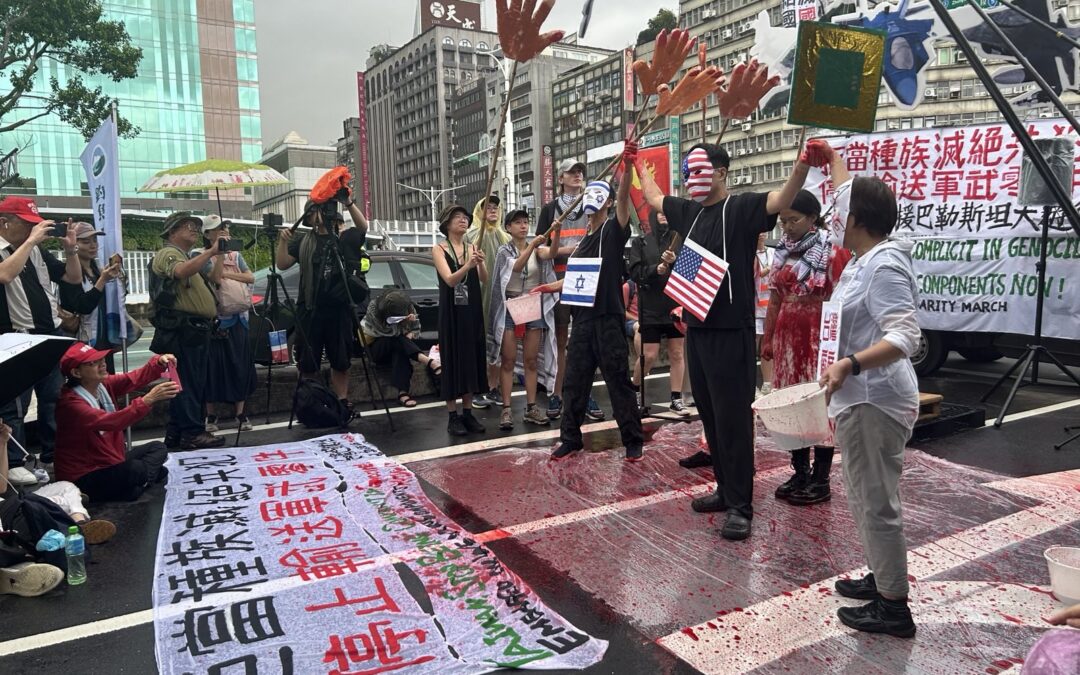
The following is an interview with friends from Taiwan who have formed the umbrella coalition Taiwan Alliance for a Free Palestine (TWAFP). The interview includes an overview of the rifts in the Taiwanese left, and the frustration of TWAFP organizers carving out their place amid divisions between pro-unification and independence, or pro- and anti-American positions, in the contentious and highly polarized politics on the island.
The organizer recounts their efforts to confront Taiwan’s growing ties with Israel and direct support for the genocide in Palestine. They speak with sadness that, even as Taiwan is now the fourth-largest supplier of arms to Israel, surpassing mainland China, most Taiwanese care little for the distant genocide and the struggle in Palestine seems far away. And yet, TWAFP has led successful demonstrations, pulled together a broad coalition of disparate groups in support of Palestine, and conducted research to expose Taiwan’s complicity in the ongoing genocide.
Be sure to read their report from 2025, outlining specific pathways of material component support for Israel, including radar, armor, and an array of military hardware.
See also a recent piece submitted to us, outlining Taiwan’s deepening ties with Israel under the DPP government.
– Chuang
Q: To begin, let’s just set the stage. Over the last few years, the Taiwan Alliance for a Free Palestine (TWAFP) has helped to organize the largest mobilizations against the genocide in Palestine seen in Taiwan. Can you tell us a little about how TWAFP formed and maybe review some of the protests it has organized?
A: Taiwan Alliance for a Free Palestine (TWAFP) was founded in April of 2024. Prior to this, Taiwan had already seen several groups doing Palestine advocacy work arise spontaneously, including Palestine Action Front, Taiwan Palestine Solidarity Network, and Parallel Government. As its name suggests, TWAFP is an “Alliance” that brings together groups that were already involved in initiatives related to Palestine. In addition to the three groups already mentioned, the alliance also includes a migrant worker organization, the Taiwan International Workers’ Association (TIWA); the human rights organization, Taiwan Association for Human Rights; the cultural collective, Taiwan Rave & Punk Solidarity Front for Palestine; the gender issues group, Queer Margins; and the Christian group, Taiwan Olive Branch Peace Collective. From 2024 to today, we have organized one petitioning campaign, issued two open letters, held one candlelight vigil, hosted one book club meeting, staged five protest actions, held three press conferences, and organized three marches. In the future, we plan to engage in a number of other activities, many of which may be smaller in scale.
Q: TWAFP also did some very interesting research on material links between Taiwan and Israel. We can link to the report here, but can you briefly go over the main findings, and maybe go over any new information that you’ve found since that report was released? For example, have there been more details since then?
A: In September of 2025, we released our report, Taiwanese Companies’ Complicity in Israel’s Ongoing Genocide, which identified specific manufacturers assisting Israel in the production of military weapons, including via the production of components. For example: Gloria Material Technology Corp (GMTC) supplies superalloys and high-grade steel produced through electroslag remelting, while ADLINK Technology supplies embedded computing systems and industrial-grade computers. In another case, Transcom marketed its vertically integrated capabilities—spanning chip design to module production—to enter the Israeli defense supply chain and is now a key, long-term supplier of components for the EL/M-2084 multi-mission radar, which is a core element of the Israeli “Iron Dome” air defense system designed by Israeli defense company Elta.
Since the primary purpose of this report was to provide accurate information that could be used by media outlets and other organizations, who would ideally follow up with their own reporting and investigation, we were relatively restrained in our writing approach and did not engage in much interpretation or extrapolation. However, when I was conducting this research, I came across a number of findings that I want to share widely:
First, every war in our present era is a “world war.” For the slaughter to continue, Israel still requires that many other countries participate in various levels of production and logistics related to the manufacture of military weapons. This is true in spite of backing from the United States, and includes small countries similar to Taiwan.
Second, there are strong political reasons for Taiwan’s willingness to export military weapons to Israel. In the last three years, the government of Taiwan has committed to building a “non-red supply chain” (非紅供應鏈)—meaning a supply chain that circumvents dependence on mainland China—particularly in sensitive fields related to national defense such as semiconductors, drones, and weapon components. In so doing, the government is attempting to promote Taiwan as the ally of “democratic countries,” marketing this cooperation as a way to reduce dependence on China.
Third, Taiwan does not excel at exporting weapons so much as manufacturing weapon components. There are two reasons for this. On the one hand, Taiwanese firms tend to manufacture components because the government’s own regulatory requirements make it difficult to export weapons.[1] By contrast, weapon components can be portrayed as dual-use products (i.e., products that could be used in weapons or in other applications) and therefore do not necessarily need to be declared as such. On the other hand, there are fewer structural limits preventing Taiwan from manufacturing these components at large scales. The manufacturing sector has long been highly developed. Taiwan’s small and medium enterprises are highly adaptable and have well-developed management systems and excellent science and engineering talent. On top of all of this, wages are lower than in Europe or North America, offering a clear competitive advantage. In addition, given the environmental externalities and pollution risks associated with the manufacturing sector, Europe and the U.S. tend to prefer that this activity occur elsewhere.
One case that we chose not to include in the report, but which we believe is a representative example of all the characteristics detailed above, is that of the firm Tatung. Tatung is a household name in Taiwan, where basically everyone has a Tatung rice cooker that gets used every day. In April 2025, the chair of the Knesset’s “Friends of Taiwan” caucus, Boaz Toporovsky, led a delegation of Israeli lawmakers on a visit to Taiwan. Abby Ya-Ping Lee, Taiwan’s official representative in Israel via the Taipei Economic and Cultural Office in Tel Aviv, took the delegation on a visit to Tatung’s headquarters, where the company expressed a desire to assist Israel in the “reconstruction of Gaza” by building out power infrastructure. While this offer of “reconstruction” sounds purely humanitarian, harmless, and depoliticized, we have to remember that April 2025 was precisely when the genocide was proceeding at its fastest pace. In other words, the more Gaza was destroyed by Israel, the more business opportunities Tatung saw. The more devastated Gaza became, the more money Tatung stood to make. Many Taiwanese firms have become entangled in the genocide in precisely this manner. Originally manufacturers of consumer goods, these companies have been guided by the governments of both Taiwan and Israel, and encouraged by foreign policy that favors “non-red supply chains” to pursue what they perceived as “apolitical” business opportunities that, in fact, quietly lend support to a genocide.
Additionally, since the report was published, some new information has come to light that is also worth noting. For example, an investigation by Al Jazeera titled “Not just the US: How 51 countries armed Israel during Gaza war,” which analyzed Israeli import data, found that Taiwan is Israel’s fourth-largest supplier of weapons and weapon components. The fact that small Taiwan quietly overtook China in this regard also surprised us. Since the trade volume between China and Israel across all commodities has historically been so large, it has been more common for people—particularly within the Chinese-language activist community—to focus on the role played by China in these supply chains, resulting in a lack of thorough research into the relationship between Taiwan and Israel. Ultimately, Taiwan’s support for Israel and its role in the genocide may be larger than people realize.
Q: So what would you say the goals and tactical limits of TWAFP are? Right now, it seems like these protests have been fairly tame, focused mostly on raising awareness, but not on actually obstructing material support for Israel. Would you agree with that? What do you see as the limits to the TWAFP project?
A: There are a few things I want to clarify here. Do you mean that our discourse is tame, or our actions? If you mean the latter, I can fully agree that our actions are very moderate. We haven’t taken direct action against Israel’s weapons supply chain. The reason is that there simply aren’t enough people in Taiwan willing to join such an action.
What must be understood is that direct action isn’t as simple as some might imagine. It takes more than a few smart, radical, and brave people to pull off. Groups like Palestine Action in the UK have considerable organization and coordination capacity. Direct action requires certain internal conditions, like enough manpower to ensure that if certain members get arrested, the long-term legal battles that ensue won’t paralyze the organization. It also requires a large enough popular base and robust media relations, so you’re not hit with a media blackout after the action. The reason we’ve taken a less direct approach is because we lack favorable conditions both on the inside and the outside [of our organization]. TWAFP is chronically understaffed and socially marginalized—if any core organizer were arrested, our operations could easily grind to a halt.
Of course, we should not be resigned to the inadequacy of our current conditions. The work of organization is by nature an art of creating favorable conditions. Direct action is always built up from ground zero and its foundation is always the people—“from the masses, to the masses,” as the saying goes.[2] We build interactive elements into our assemblies, marches, and events, so that people aren’t just passive participants, but can think together about what more could be done. The goal is to equip them with more radical ideas, inspirations, and capacities, and to build initiative for collective escalation. Within the alliance, there’s no shortage of members who believe in and support direct action. But our power is limited, so everything must be organized and advanced slowly, step by step.
For example, unlike typical rallies where everyone goes home after slogan chanting, at one rally we asked protestors to stay for a brainstorming session with us on the spot. About 300 people stayed. We thought: since these people had already shown up, which meant they cared enough about the genocide, could we do something meaningful and effective together? We invited everyone to join the discussion with the hope of guiding them toward thinking about direct action.
The discussion also made us realize that, aside from a small number of us who were already core organizers and active volunteers within TWAFP, most protestors actually wanted us to do more awareness-raising activities rather than escalating our actions. We were surprised to discover how removed the alliance was from the people. This is also why our work looks so tame right now—it is a response to the needs of the broader base of Palestine supporters.
But I think calling us tame is also a bit misleading, even if we’re just organizing symbolic marches, protests, press conferences, or reading groups. To us, these are just organizing tools. We’ve never given up on making gradual advancements through these activities so that one day the flower of direct action may bloom. It’s all part of a process. We’re still developing, we need time. Does this mean we’re tamed? Haha, I don’t think so personally. We just haven’t grown enough to be able to really take off. I hope more Chinese-speaking friends familiar with the local context will reach out, join us, and become organizers in this movement.
Q: This touches on some larger issues in Taiwanese politics that won’t be immediately clear to most audiences. So it might be helpful to review the contours of the Taiwanese political scene. First, can you briefly explain the major splits in establishment politics in Taiwan (for example, DPP vs. KMT) and how each approaches the question of Israel?
A: So, the two largest parties in Taiwan are the Kuomintang (KMT) and the Democratic Progressive Party (DPP), the blue and the green, respectively. In recent years, the Taiwan People’s Party (TPP) has also drawn considerable attention; their color is white. The DPP is the current ruling party.
The DPP is all about Taiwan independence. They’re diplomatically aligned with the U.S. and distanced from Beijing. Some members of the Tangwai movement (黨外運動), which preceded the DPP, once identified with and publicly supported Palestinian independence and statehood, but that was decades ago. In recent years, the DPP government has been cozying up to Israel. Looking at communications from the Ministry of Foreign Affairs under DPP rule, it’s obvious that the official line on Israel has shifted from vague statements about “shared values of democracy and freedom” to something much more concrete, like cooperation on the “non-red” or China-free supply chain. The DPP government believes that Taiwan must win the support of Western democracies—the U.S. above all—by demonstrating its value through tech and the arms industry. This, they insist, is the only way to avoid being “abandoned” by the West when it comes to the China threat. The radical DPP supporters, like Huang Wen-ju, even envision Taiwan as the Israel of East Asia.[3]
This also explains why the DPP government moved quickly to impose an arms embargo on Russia in the beginning of the war in Ukraine, but dragged its feet on the genocide in Palestine. The Ministry of Foreign Affairs says it’s up to the Ministry of Economic Affairs; the Ministry of Economic Affairs says it’s not their decision to make. Different ministries keep passing the buck, each saying it’s not their job. It’s not that Taiwan can’t impose an arms embargo on Israel, it’s that they won’t. Taiwan doesn’t want to risk offending the U.S.-led “free world.”
Beyond the DPP, there’s also the KMT, which is the former ruling party, whose official line is “one China, different interpretations” (一個中國, 各自表述)—with “one China” referring to the Republic of China rather than the People’s Republic of China. Of course, “one China” as a concept exists in fundamental contradiction to “different interpretations,” but that tension is precisely what has given generations of KMT leaders so much room to maneuver. Ma Ying-jeou emphasized the “different interpretations” during his presidency. But now, with Cheng Li-wun as chairwoman, the KMT has shifted more toward “one China.” Diplomatically, the Nationalists are relatively friendlier with China and advocate being “close to the U.S., friendly with Japan, and at peace with the mainland.”[4] Their position on Israel is less clear since they’re not the current ruling party.
It’s worth mentioning that, on the issue of U.S. arms sales to Taiwan, the KMT has repeatedly opposed the DPP’s budget proposals. It has also been accused of playing into Beijing’s “cognitive warfare” against the U.S. and fueling narratives of so-called “U.S. skepticism” (疑美論). The KMT, for its part, argues that its fundamental position hasn’t changed and that “U.S. skepticism” is a label fabricated by the ruling party for political gain. I actually agree with them on this point. I don’t think the KMT is suspicious or critical of the U.S. in any meaningful way. They just oppose whatever the DPP proposes domestically to win over voters unhappy with the DPP.
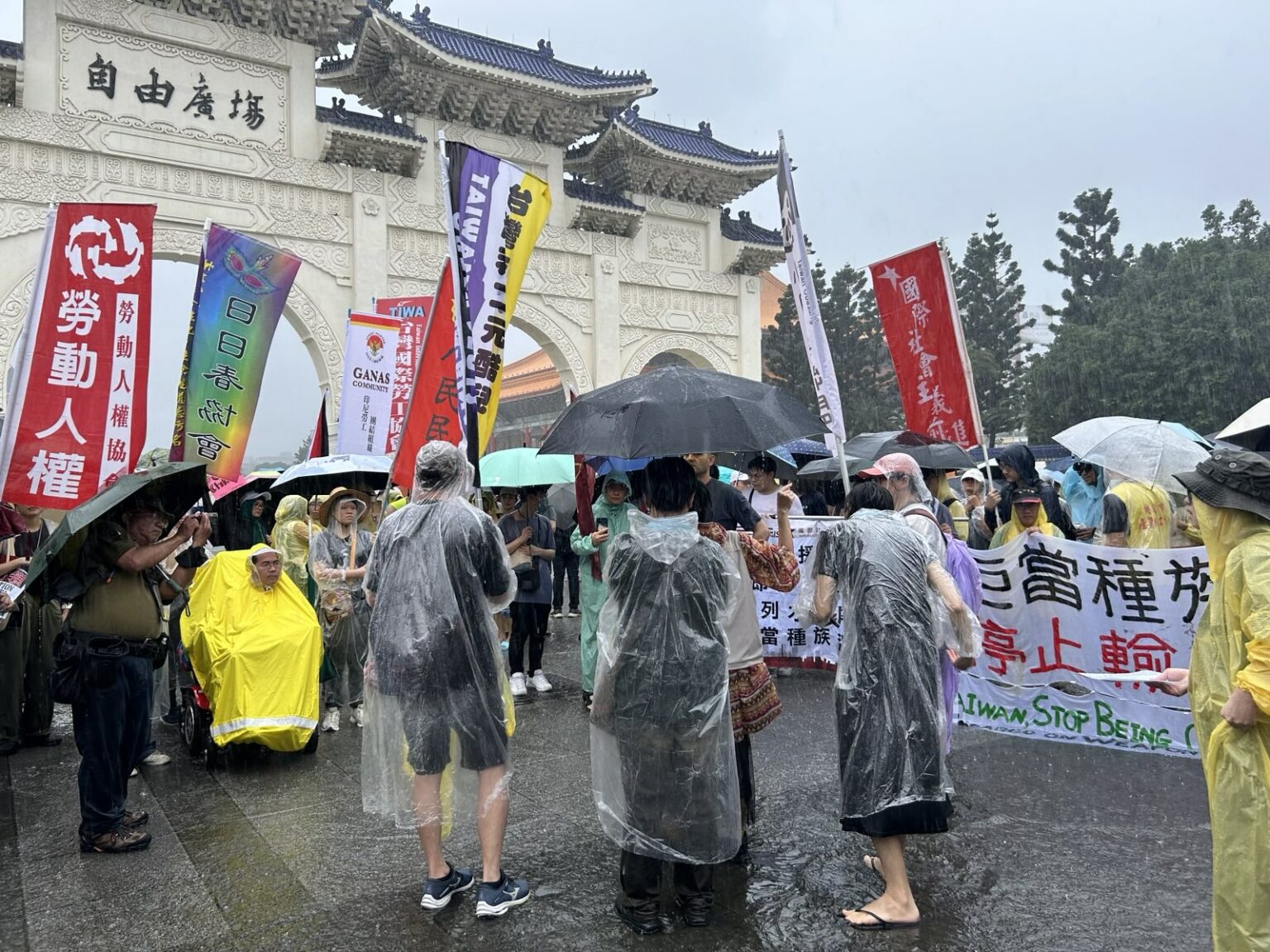
Q: Second, can you give us an overview of the left in Taiwan? What are the major dividing lines? What are the largest organizations? Is there anything like a genuine communist left? What about an anarchist movement?
A: This is such a sensitive question. To be honest, anything I say is going to offend a lot of people. The best I can do is describe things as objectively as possible and point out where the lines are contested.
The Taiwanese left could be roughly divided into four camps based on their stance on unification with vs. independence from the PRC:
The first camp is usually referred to as the “pro-unification left” (統左), “leftist pro-unification” (左統), “the left” (左派), or “unificationists” (統派). To outsiders, these labels all point to the same group of people: those on the left who support the peaceful cross-strait unification of the Chinese nation and oppose Taiwan’s independence. Amongst themselves, however, these words signal entirely different political lines. For instance, “leftist pro-unification” (左統) insists that leftist principles take priority over nationalism, and that critique of capitalism cannot be set aside for the sake of unification; whereas the “pro-unification left” (統左) believes that national unification and leftist ideals are one and the same, with neither taking precedence. As a result, the former tends to be more critical of the Chinese Communist Party’s political and economic problems, while the latter tends to be more supportive of the CCP. In everyday organizing, people can be quite offended if you mistake one for the other, and you’ll be marked as an outsider who doesn’t know the scene. At the same time, the “pro-unification left,” the “leftist pro-unification” and “the left” all insist they are not “unificationists” because they consider their pro-unification stance as one still grounded in leftist principles and distinct from the blindly nationalistic “little pinks” (小粉红).[5] To some outside observers, however, these groups are all effectively unificationist because they are by definition not critical enough of the CCP.
An example of this first camp is the Labor Party (勞動黨)—whether they are considered the “pro-unification left” or “leftist pro-unification” depends on the vantage point of the observer. Its founding members, like Lin Shu-yang (林書揚), were victims of the White Terror in the 1950s and organizers in the labor movement. These were people who had been persecuted, tortured, and killed by the KMT. The younger generation are often descendants of political prisoners of the White Terror, or those who have some knowledge about and concern for this history. The Labor Party is currently struggling with a serious generational gap in membership, which is tied to their closed organizational culture.
The second camp could be called “neither unification nor independence” (不統不獨). As the name suggests, they support neither unification nor independence, but the term itself could be interpreted in two different ways. The first interpretation insists that the question of unification or independence is secondary to more immediate questions of livelihood and should be set aside for now. The second maintains that the key problem isn’t whether to unify or to become independent, but how to do so. Ultimately, this camp doesn’t opine as much on the issue. Of course, a small subset is actively thinking about and debating the paths, possibilities, and preconditions of unification or independence. But, because open engagement is generally read as unificationist, these conversations usually stay private.
Some people I know in the “neither nor” camp prefer to keep their distance from the first camp because they don’t want the question to overshadow other issues they care about. I also have some “neither nor” friends who are on good terms with the “pro-unification left,” the “leftist pro-unification” and “the left.” They are willing to work together and support each other. This is because they are against certain pro-independence figures and DPP supporters—the so-called “pro-Taiwan camp” (台派)—lumping all these old leftists with genuine leftist ideals together and branding them all as “unificationist,” even to the point that they don’t consider such individuals as victims of political violence when it comes to discussions of transitional justice [i.e., Taiwan’s retrospective discourse around the crimes of the KMT dictatorship]. There is, of course, more nuance to the “pro-Taiwan camp” and not all refuse to account for leftist victims of the White Terror. That said, those within the “neither nor” camp who keep their distance from the various groups in the first camp in order to prioritize other issues do so out of concern that engagement is tantamount to political suicide by association. Meanwhile, those within the “neither nor” camp who continue to engage with the “pro-unification left” believe that avoiding association out of fear of external judgment signals a lack of political confidence, ethics, and camaraderie.
All in all, you’ll find “neither unification nor independence” leftists on the front lines of almost every social movement and labor movement, especially migrant worker organizing. They rarely fly the banner of “neither nor,” but are generally very active, very hands-on in social movements.
The third camp is known as the “independence left” (左獨). They hold a stronger anti-CCP position and harbor more suspicion about unification with China, while still maintaining a critical stance toward capitalism and U.S. imperialism. One clear marker of the “independence left” is vocal support for the struggles in Ukraine, Xinjiang, Tibet, and Hong Kong. Some friends in this camp are more invested in indigenous rights and critical of Han settler colonialism. Others pay particular attention to peace movements along the First Island Chain (第一岛链) and oppose the American military occupation of Okinawa[6] and Jeju Island.[7] But I’ve also noticed that sometimes the pro-independence left struggles to distinguish itself from the pro-independence camp at large, just like the left generally has a hard time distancing itself from the pro-unification stance. This is because discussions of Taiwan’s path to independence mostly assume some reliance on U.S. or Japanese power—some are even happy to let the U.S. use Taiwan as part of its First Island Chain strategy against China. Despite their critiques of U.S. militarism, pro-independence leftists can’t yet offer an alternative, which is why it is sometimes hard to identify leftists within the umbrella of pro-independence.
During the Sunflower Movement, the “Black Island Nation Youth Front” (黑色島國青年陣線) became a representative of the pro-independence left position.[8] But after the movement, many Black Island Youth members moved into the establishment, some even becoming key figures in the DPP. The Youth Front and the so-called “independence left” faction disappeared from public view for a while. Nowadays, many pro-independence leftists are active around New Bloom magazine (破土) and Daybreak Café (破曉咖啡) in Taipei. Interestingly, a lot of them speak very good English or have lived abroad.
The fourth camp consists of anarchists. Like anarchists everywhere, they are critical of nationalism and opposed to capitalism. A lot of the time, however, they can come across as apolitical and generally unorganized. Anarchists in Taiwan are further split into two roughly parallel communities: one Chinese-speaking, one English-speaking. Chinese-speaking Taiwanese anarchists are largely influenced by Japanese anarchists, like Matsumoto Hajime’s group “Amateur Riot” (素人之乱), later reorganized as the “East Asian Stupids” (東亞大笨蛋), which is a major part of their transnational network. They founded the “Untouchables’ Liberation Area” (賤民解放區) during the Sunflower Movement to protest the student movement’s hierarchical organizing culture, and were strongly critical of free trade. They can be seen hanging out at Halfway Café, Bei Fong She, and punk shows. The English-speaking Taiwanese anarchists also hang out at Daybreak Café.
This is just to give you a rough sketch of the landscape. Of course, no individual or organization fits neatly into any category. Someone can be both “neither unification nor independence” and “anarchist” at the same time. “Neither nor” might be their approach to strategy, while “anarchist” might be their political identity. Or take the group “Parallel Government” (平行政府) and their bookstore “Left Wing Books” (左翼書房) for example. They might position themselves somewhere between the first and the second camps. They’re not aligned with the Labor Party. But because they’re pretty quiet about Xinjiang, Tibet, and Hong Kong, even dismissing state surveillance in these places as exaggerated American propaganda, they get labeled as “leftist pro-unification” by outsiders. Some on the right even consider them outright “unificationist.”
As for me, I often find myself in between all four categories. I have a great deal of sympathy and understanding for the left, and I really agree with their critique of the U.S., but I can’t get on board with their views on Hong Kong and Xinjiang. I feel a lot of revolutionary camaraderie with the “neither nor” folks, who might be socialist, communist, Trotskyist… they are good comrades, but my own tendency leans decidedly more anarchist. I’ve also had opportunities to work with pro-independence leftists, but sometimes feel that they hold too much hostility toward “the left” (左派), which makes me quite sad. I feel most at home among anarchists but have a hard time finding comrades there to build political organization with. The way I see it, every faction of the left in Taiwan is stuck being unable to find an alternative path between pro-U.S. and pro-China positions. Sometimes I feel like we have found it, but we just don’t have the courage and the confidence to turn it into an actual program.
In Taiwan, before you manage to fully articulate your own position, you’re already under attack from all sides who dismiss you as “unrealistic.” But the so-called “realistic” options (pro-China vs. pro-U.S.) are actually more unrealistic, because neither offers a sustainable political and economic model. Taiwanese debates about what counts as “realistic” or “unrealistic” are hardly rational or empirical. They’re always about emotion and intuition. How to get people to see the absurdity of the supposedly realistic path—or the unrealistic aspect of so-called realpolitik—and moreover, to commit to a path that everyone else considers unrealistic? This demands from us a bold, rebellious bravery.
Q: Now let’s return to the core question: how is Palestine situated within this political scene? How were the protests received among the general public? What level of participation did you see across the left?
A: Palestine might be the one issue capable of bridging the divides among these camps and making them work together. In fact, even before TWAFP was founded, groups associated with “the left” like Parallel Government, The Left Party (左翼聯盟), and the Diaoyutai Education Association (釣魚台教育協會) had already organized protests and discussion forums. The Taiwan Palestine Solidarity Network, which would be classified as “independence left,” also organized actions at a more grassroots level. What our alliance did was to bring people, networks, and resources together to scale up the movement.
Beyond spanning different leftist circles, TWAFP also reaches into liberal circles, working with left-liberal friends and groups focused on human rights. Of course, this collaboration is not without tension between different groups and factions, but I don’t think this tension should be overstated. Collaboration inherently requires communication and working through friction. Having tension is actually a good thing: it means that we’re talking and getting to know each other, that we’re trying to understand, debate, and get closer to one another. I think TWAFP has been fairly successful within the left. Most politically active leftists in Taiwan agree that supporting Palestine is important. This doesn’t mean they are actively involved in solidarity work. It’s just that we have basic alignment on the Palestine question.
Nonetheless, Palestine remains a marginal issue in the eyes of the public. Our marches usually draw up to 600 people. Not a huge number, but it’s already the biggest Palestine solidarity action in Taiwan. The Taiwanese media deliberately avoid covering us, as if trying to pretend we don’t exist. So, even with everything we’ve done, our media exposure remains very low. But I do sense our influence is increasing. More people are starting to realize that Israel is a colonial state, or at least understand that genocide is inexcusable.
Q: Obviously, the situation is worsening, with Israel now extending its brutality into Lebanon, the U.S. effectively initiating war with Iran, and Iran firing off defensive attacks against imperial interests across the Gulf States. This has then triggered a major spike in global oil prices, particularly severe in places like Japan, Indonesia, and Taiwan, all of which are heavily reliant on oil passing through the Strait of Hormuz. So what is the attitude in Taiwan now with regard to these events in Iran? Is the inflationary spike causing any dissatisfaction?
A: I don’t think people in Taiwan are engaging in any sort of in-depth discussion about this issue, but they’re definitely worried about the war’s impact on the stock market. Many assume it’s just a temporary blip, and that oil and stocks will stabilize soon enough. But that’s not based on any actual analysis or understanding of what’s going on. It’s mostly wishful thinking, because honestly, most people feel like there’s nothing they can do anyway. They feel helpless and powerless. Some pro-U.S. members of the pro-Taiwan camp, like Akio Yaita and Wang Hao, keep saying “Don’t worry, Daddy America’s got this, everything will be fine.” Regular people, on the other hand, just throw up their hands and quietly resign themselves to the sense that there’s nothing to be done. I know some labor groups are trying to push back, but they’re really struggling. The truth is that Taiwan isn’t much of a player in this. We have no real bargaining power. It’s like the whole world is being hit by a massive tsunami, the windows are about to shatter, but we can’t change the weather.
Q: And has TWAFP held any protests against the war in Iran or the invasion of Lebanon? Are there plans to?
A: TWAFP doesn’t have a plan right now, but some of our partner groups have organized responses.
For example, an anarchist group called “Supreme Master Hometown Association” (無上師同鄉會) went to the U.S. embassy on the evening of the Fourth of July and sang a rewritten version of Happy Birthday to express anger about the war on Iran. It wasn’t a huge turnout, thirty people tops, but it was fun and meaningful. Some student organizations like the National Taiwan University Labor Club also held gatherings, with ten or so participants. I don’t think there’s enough public awareness to organize a march, so fundraising and awareness-raising activities probably make more sense. The most successful Iran-related action was organized by friends from Taipei in Solidarity—a group of primarily English-speaking leftists with anarchist leanings. They are some of the best community organizers I know. Their event drew about a hundred people.
Regarding the attacks on Lebanon, the music and cultural group SSSounds Without Borders (無國界之聲), the punk band Suck Glue Boys, and Halfway Café co-organized a fundraising and educational event. About fifty people showed up. It was also very lively and heartfelt. Like with the Iran war, we need more time to do translation, contextualization, and education before political mobilization.
Q: After the election of Lai Ching-te, it seems like right-wing nationalism has been on the rise in Taiwan. Lai’s administration has repeatedly threatened anyone deemed sympathetic to Beijing, particularly targeting naturalized citizens from the mainland, from Hong Kong, and from Macau, as well as immigrants from elsewhere (for example, deporting two Japanese influencers in 2025). Has this rightward shift impacted your work at all? Does it threaten the continued existence of TWAFP?
A: For now, I think TWAFP is still safe. Censorship and surveillance are not the most serious problems in Taiwan at the moment, and we’re a small group with limited influence. But it’s true that we’ve received government attention disproportionate to our actual reach, especially when we criticized the Taiwanese government for becoming the first in the world to directly fund settlement infrastructure in the West Bank. The Foreign Ministry’s reaction made it clear that they feared us, which shows how terrified the government is of losing face internationally. When our friends went to protest at a defense technology exhibition, the government also deployed disproportionate force to contain our activities, even surveilling and detaining our comrades. A foreign friend who was only there to document the protest still faced legal investigation, and only got cleared after a human rights group intervened.
Even so, I don’t think the government poses the biggest obstacle to our organizing. The greater problem is that, since Lai Ching-te came to power, public feelings have gotten more right-wing, more pro-U.S., more steeped in Taiwanese nationalism. In this climate, whenever we criticize the U.S. military-industrial complex and its backing of Israel, people call us “U.S. skeptics.” Some even say that, because Palestine recognizes the People’s Republic of China, we must all be lackeys of the CCP.
From where we stand, it is of course justifiable, even necessary, to be suspicious of the U.S. But in the Taiwanese context, “U.S. skepticism” is a pejorative term that marks us as supporters of the KMT. Or worse, suggests that we are waging cognitive warfare on behalf of Beijing, spreading distrust of America among the Taiwanese. Being called a “U.S. skeptic” in Taiwan today basically means you are a supporter of “authoritarianism” and “totalitarianism.”
In Taiwan, nothing provokes more fear than authoritarianism and totalitarianism. This fear comes from historical experience. In 1949, the People’s Republic of China was founded and the Nationalists set up a government in exile in Taiwan. To ordinary Taiwanese, however, the KMT was just another colonizer. The KMT treated the island as a staging ground to retake the mainland and imposed one of the longest periods of martial law in human history to crush any dissent that might threaten their rule. Corruption was rampant under KMT rule, and there was extreme suppression of critical thinking. It wasn’t until martial law was lifted in 1987 that things began to change. After democratization, people became terrified of authoritarianism making a comeback, and the youth today are especially mistrustful of the KMT.
The fear of totalitarianism, on the other hand, can be attributed to two factors. One is a real, material threat: the CCP’s crackdown on free speech, and China’s recent military exercises that keep the Taiwanese in constant fear of invasion. The other is the legacy of the Cold War. The martial law era saw the severe suppression of both leftist and pro-independence thought. It was basically our version of the American Red Scare. This historical memory instilled a deep fear of Chinese Communists in Taiwan.
This means that the pro-Palestine movement in Taiwan must push back against all these accusations of us being KMT supporters or CCP stooges. It’s not just regular people who are suspicious of us. Some NGOs are so spooked that they won’t work with us, and won’t take a public stance on Palestine. Regardless, we must fight against the stigmatization of so-called “U.S. skepticism.” We must keep explaining the problems with America and Israel, and why Taiwan shouldn’t endorse a world order built on the hegemony of militarism and oil money.
What we’ve seen happen a lot is that no matter how hard we try to explain our political position, most people just don’t get it. Everything gets filtered through the blue vs. green, unification vs. independence binary before it ever enters public conversation. If you’re neither blue nor green, people literally have no idea what you’re talking about. They see us as irrelevant, if not politically nonexistent, which is heartbreaking. The fact is, Taiwan is exporting military goods to Israel. That’s concrete, undeniable evidence that the genocide in Gaza has something to do with us, that we have a responsibility to break the toxic alliance. But Palestine still seems too far away for most people. They can’t make the connections between what’s happening there and their own lives.
[1] For example, in November 2025 Taiwan announced further tightening of its export controls on dual-use technologies, requiring government approval for exports of strategic high-tech commodities and military-listed items. See Reuters, “Taiwan to further tighten export controls for dual-use technology,” November 18, 2025, https://www.reuters.com/world/asia-pacific/taiwan-further-tighten-export-controls-dual-use-technology-2025-11-18.
[2] The phrase comes from Mao Zedong. The full passage reads: “In all the practical work of our Party, all correct leadership is necessarily ‘from the masses, to the masses.’ This means: take the ideas of the masses (scattered and unsystematic ideas) and concentrate them (through study turn them into concentrated and systematic ideas), then go to the masses and propagate and explain these ideas until the masses embrace them as their own. . .” Mao Zedong, “Some Questions Concerning Methods of Leadership” (June 1, 1943), in Selected Works of Mao Zedong, Vol. III (Beijing: Foreign Languages Press, 1965), 119. Available at https://www.marxists.org/reference/archive/mao/selected-works/volume-3/mswv3_13.htm.
[3] Huang Wen-ju (黃文局), also referred to as Victor Huang, founder of the Global Taiwan Research Institute, authored《世局:借鏡猶太史,走出台灣自己的路》(World Affairs: Using Jewish History as a Mirror to Forge Taiwan’s Own Path), published November 2024 (圓神出版社). In it, he argues “If Israel can, Taiwan can; if Jews can, Taiwanese can” and advocates transforming Taiwan into an “Israel of the East.” See Storm Media, “黃文局新書『世局』詳解以色列為何強大以猶太史借鏡台灣,” December 2024, https://www.storm.mg/article/5275617.
[4] This is a standard KMT talking point. See, for example, KMT Chairman Eric Chu: “We advocate being close to the United States, friendly with Japan and having peace with the mainland,” ABC News, November 26, 2022, https://www.abc.net.au/news/2022-11-26/taiwan-votes-in-local-elections-amid-tensions-with-china/101702184.
[5] For analysis of “little pinks” and Chinese youth nationalism, see Chuang, “Wandering Earth: China’s Blockbuster and the Rise of the Little Pink,” August 2019, https://chuangcn.org/2019/08/wandering-earth/
[6] After the Battle of Okinawa in 1945, the islands remained under U.S. administration until “reversion” to Japan in 1972, while extensive U.S. military bases remained in place. Land seizures and militarization generated sustained local resistance, which continues today around the new Marine facility at Henoko. Okinawa still hosts dozens of U.S. military installations, making the postwar American military presence a continuing feature of island politics. For a recent account sympathetic to the anti-base movement, see Jon Mitchell, “Islands of Peace?,” Foreign Policy in Focus, June 26, 2026, https://fpif.org/islands-of-peace/.
[7] Jeju was under the U.S. Army Military Government from 1945 to 1948. Amid mass opposition to the division of Korea, a 1947 general strike, and growing conflict with the occupation authorities, the U.S. military government came to regard Jeju as a “Red Island”; repression escalated, followed by the April 3, 1948 uprising and the extraordinarily violent counterinsurgency now remembered as the Jeju 4·3 massacre. The contemporary anti-base movement draws an explicit line between that history and the island’s renewed militarization. The naval base at Gangjeong, completed in 2016, is formally a South Korean rather than a U.S. base. Anti-base activists nevertheless argue that, because it is integrated into the U.S.—ROK alliance and accessible to U.S. forces, it functions in practice as part of the U.S. military architecture in the Indo-Pacific. See Christine Hong, “Over 5,000 Days of Resistance: An Interview with Anti-base Activist Choi Sung-hee on the Gangjeong and Jeju Struggle for Peace,” Korea Policy Institute, April 2, 2021, https://www.kpolicy.org/post/over-5-000-days-of-resistance-an-interview-with-anti-base-activist-choi-sung-hee-on-the-gangjeong-a.
[8] The Black Island Nation Youth Front (黑色島國青年陣線), founded in 2013, was an important group in the Sunflower Movement in the spring of 2014, and explicitly identified itself with a “left independence” (左獨) position, combining Taiwanese independence with left-wing politics. See “Interview: Lai Yu-Fen,” Daybreak Project, December 8, 2016, https://daybreak.newbloommag.net/2016/12/08/interview-lai-yu-fen/.
The left out hanographs:
Halfway Café: 半路咖啡
Bei Fong She: 北風社
Akio Yaita and Wang Hao: 矢板明夫、汪浩
Lai Yu-fen: 賴郁棻